|
|
|
Eudoxus was a prolific writer of scientific subjects, and thinkers such
as Euclid incorporated much of his work into their own. He mapped out
the constellations, and the result became the main star reference for
hundreds of years. Among other feats, he divided the sky into degrees of
longitude and latitude and devised a better calendar. He was also a well
known geographer and mathematician, but it was his work on astronomy
that he is principally remembered.
Later Greek stories arose about Carnabon, a king of the Getae, who killed
a famous dragon, or even of Heracles, who (you might recall) killed
Draco. Thus the story of the man and serpent came to represent a host of
individuals, but most authorities now seem to opt for Asclepius, or
Aesculapius, which is the Latin equivalent of the Greek god of medicine.
Asclepius became the Argonauts' surgeon, sailing with them on the ship
Argo, and he managed to bring back to life a number of people, including
the son of King Minos of Crete.
It was after Asclepius tried to revive Orion, bitten by the scorpion,
that Pluto began to complain. He argued to Zeus that if Asclepius had
his way he would rob Pluto of the entire population of Hades. Zeus agreed;
they couldn't permit men to be immortal. So he sent a thunderbolt to end
Asclepius's life.
Zeus later put Asclepius in the heavens along with the Serpent. The
serpent has long been a symbol for renewed life.
While the cult of Asclepius began in Thessaly, temples were built throughout
Greece, especially near healing springs. Around 300 BC the cult arrived
in Rome.
Ancient sculpture typically shows the god bare breasted, attired in a
long flowing cloak, and holding a staff with a serpent coiled about it.
This is perhaps the forerunner of the modern medical symbol of the
caduceus.
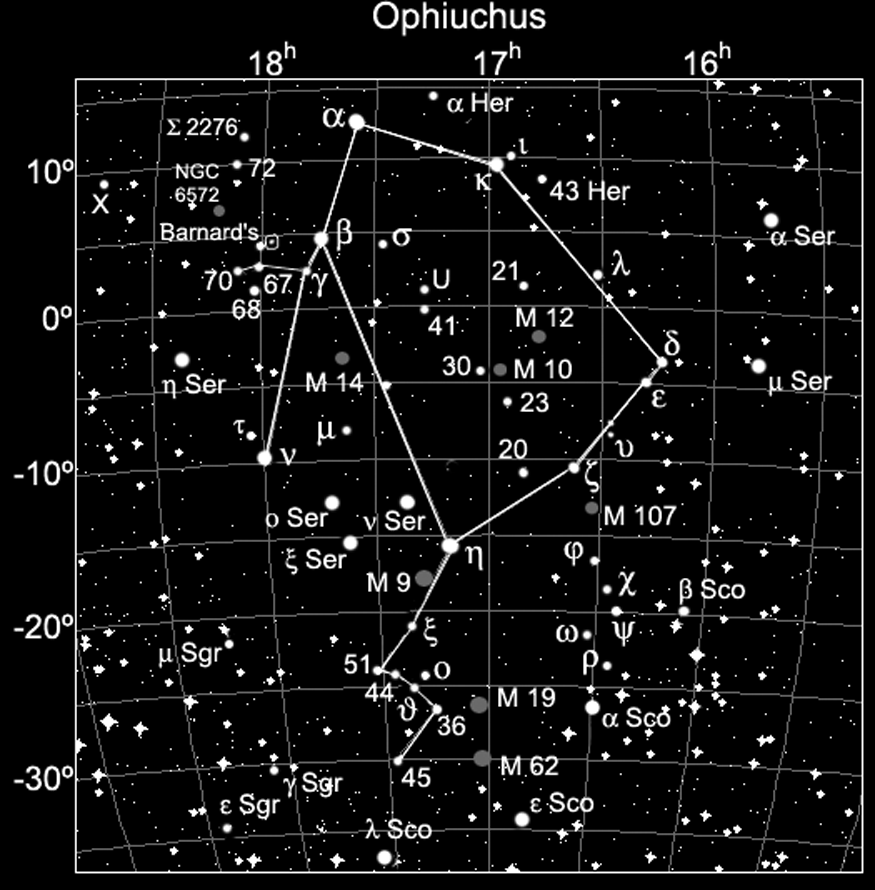
The Bayer stars of Ophiuchus are fairly
bright, five of which have a magnitude brighter than 3.0.
The brightest star, alpha Ophiuchi, is better known as
Rasalhague, meaning "Head of the Snake Charmer". This is a rather
close star, at 54 light years away, and a celestial neighbour of Ras
Algethi (alpha Herculis), which lies to the WNW five degrees.
The region encircling rho Ophiuchi is also of some interest. This area
contains several dark clouds and nebulae that show the active formation
of stars.
[NOTE: See the Binocular Section, below, for updated binary values]
Ophiuchus has one of the finest collections of double stars, including
several close visual binaries.
Lambda Ophiuchi is also a rapid binary.
4.2, 5.2; currently the PA is 27º and its separation is 1.5".
Xi Ophiuchi: 4.5, 9.0; PA 50º, separation 3.7".
Rho Ophiuchi: 5.3, 6.0; PA 344º, 3.1".
Tau Ophiuchi: 5.2, 5.9; with an orbit
of 280 years. Presently the companion is at PA 282º and
separation 1.7".
36 Ophiuchi is a binary with period of 548 years, of two equal stars: 5.1, 5.1; 148º, 4.9".
70 Ophiuchi is another close binary with
a period of 88.3 years. 4.2, 6.0. In 2000.0 the values are PA 149º
and separation 3.7".
Struve 2276. This is a very beautiful fixed binary of two fairly faint
stars: 7.0, 7.4; PA 257º, separation 6.9".
Chi Ophiuchi is a gamma Cas variable: 4.2-5.0.
U Ophiuchi is an Algol type (EA) variable: 5.84-6.6 every 1.7 days.
X Ophiuchi is a long-period variable, 5.9-9.2 with a period of
328.85 days. In the year 2000 the maximum should occur during the last
week of March.
There are six Messier objects in Ophiuchus: M9, M10, M12, M14, M19, and
M62 (and one more as well, if you accept M107 as a true Messier). These
are all globular clusters.
In the same field are two more globular clusters: NGC 6342 (1 degree SE)
and NGC 6356 (1 degree NE).
M19 (NGC 6273) is another very dense cluster, usually described
as "oblate", meaning it's a bit egg-shaped. It is about 25000 light
years away.
M107 (NGC 6171) is the faintest of the bunch and quite small. This
is one of those "Messiers" that were added to the original list, for
some reason. It's three degrees SSW of zeta Ophiuchi.
B78, the "Pipe Nebula", is a naked eye dark nebula two degrees
southeast of theta Ophiuchi, in very rich area of the Milky Way.
Barnard's Star is the most rapidly moving star relative to the
solar system, with a proper motion of 10.31", and the second closest star
to us, at a distance of 5.91 light years (if you accept the three-star
system of alpha Centauri as a unit).
The star is three degrees due east of beta Ophiuchus. The actual
location (Epoch 2000) is R.A. 17h58m; Decl. +04 degrees, 34 minutes.
A slight oscillation in both the right ascension and declination of
Barnard's Star has led observers to suggest the possibility that one or
more planets orbit the star.
For a more detailed appreciation of Ophiuchus, visit the Binocular Section.
Or go to
the Main Menu
|