|
|
|
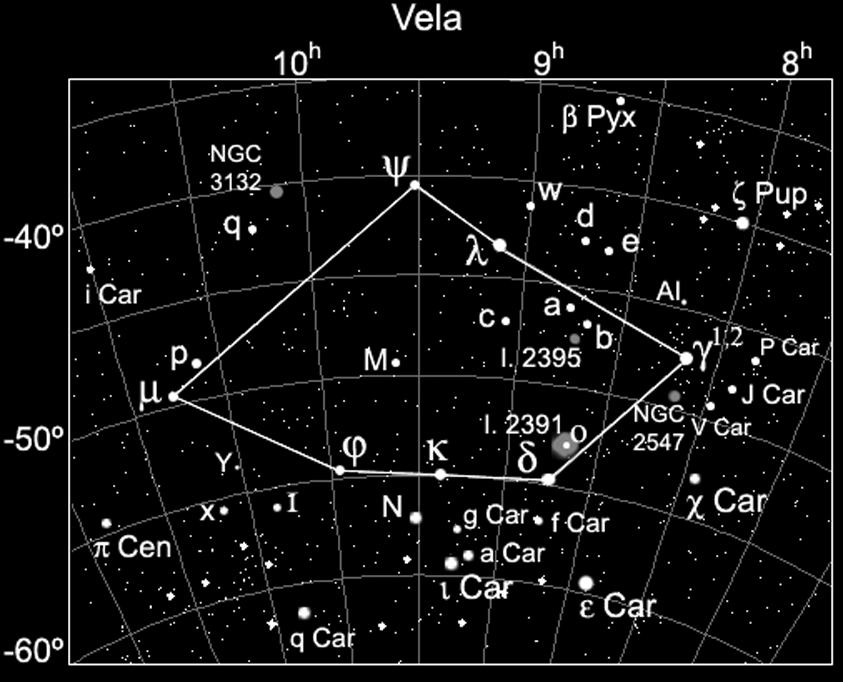
As mentioned in regard to "Carina", Jason and his Argonauts sailed off in the Argo Navis to capture the Golden Fleece. The constellation that commemorated that adventure is now broken up into three smaller constellations: Carina (the Keel), Puppis (the Stern) and Vela (the Sail).
The stars that make up the sail are widely dispersed. Some cartographers of
the night sky add a few more stars to make the sail more billowy. Since Vela
is part of the original Argo Navis, it has only a few of the Bayer stars of that larger constellation.
Sometimes observers associate the lower two stars, kappa Velorum and delta
Velorum, with iota Carinae and epsilon Carinae, and believe they are looking
at the Southern Cross. The real Southern Cross is in the nearby constellation
of Crux; this cross shared by Vela and Carina goes by the name of the False
Cross.
Although Vela does not make much of a sight in the southern skies, it
does have a number of notable objects, including the brightest Wolf-Rayet
star, an optical pulsar, and a pulsating variable which is the prototype
of an entire class of cepheids.
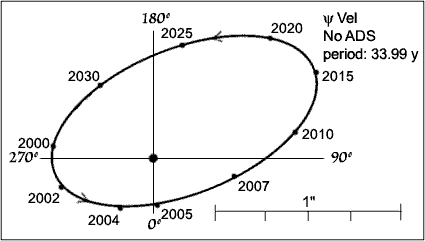
Psi Velorum is the most interesting binary in Vela. It is a close
visual binary with a very rapid orbit.
Presently the values are: 3.9, 5.1; 112º, separation 1.0".
Y Velorum is a Mira-type variable, from 8.0 to 14.2, every 444.61
days. In the year 2000 the maximum should occur around the second of
January.
AI Velorum is a notable pulsating variable now grouped into a
select number called dwarf cepheids. This star is the brightest
of the 70 or so known dwarf cepheids, varying from 6.4 to 7.1, bright
enough to be classified by the Webb Society as a "binocular variable".
Pulsating variables change in visual magnitude due to sporadic movement
in their outer layers. The pulsation occurs when there is an imbalance
between gravitational pull (inward) and gaseous pressure (outward),
causing a continuous cycle of expansion-contraction. [See Valerie
Illingworth, Facts on File Dictionary of Astronomy for a detailed
explanation.]
While the brightest of the known dwarf cepheids, AI is not that easy to
find. First locate gamma Velorum, then move up three degrees where you
find a fairly bright but unnamed star (HD 68217). In the same view you
should see AI to the southeast one degree. If this method proves difficult,
you might try the finder's chart in Burnham, p. 2039.
Named after C.J.E. Wolf and G. Rayet, who discovered the existence of
this type of star in 1867 (at the Paris Observatory), these stars are
essentially left-over centres of giant O stars, which have ejected their
helium and nitrogen atmospheres. These stars are typically around ten solar
masses, and many of them are binaries (such as gamma Velorum).
Most Wolf-Rayets are quite distant from us; gamma Velorum is the closest
known W-R star at an estimated 550-800 light years, although some catalogues
list a greater distance.
IC 2395 is another open cluster, much smaller and considerably
fainter (it's about 3000 light years distant) but it contains about
twice as many stars as IC 2391.
The cluster is nearly six degrees east of gamma Velorum, in a particularly
dense part of the Milky Way. It might be easier to find the most prominent
star in the area first.
This star (b Velorum), 3.9m, is a bright binary (companion is a 10m
star, very wide separation: 37.5"). It's five degrees east of gamma Velorum,
and about one degree north, in the middle of a particularly rich area of the
sky, but clearly the brightest star in the area.
Now star-hop south. First, at about one degree south is n
Velorum (4.77m). Then at two degrees south of b Velorum you'll
find a rather dimmer star (HX Vel, 5.5m, a variable and binary). This
star is probably not a part of the IC 2395 cluster as its distance is
considerably closer than the cluster's).
In the same viewing area as HX Velorum, about half a degree east, is IC 2395.
You'll see another cluster in the same field, to the southeast: NGC 2670,
which is similar in size and brightness.
NGC 3132 has a fairly bright 10m central star which (as Burnham points
out) isn't really the star which is furnishing the nebula's illumination.
This light comes from a 16m dwarf companion (separation 1.65") which has a
very hot surface, about 100,000 kelvin.
Unlike most planetary nebulae, this one isn't round, but is more oblong,
which gives it the name it sometimes goes by: the Eight-Burst Nebula. It
is estimated at from 2000-3000 light years away. It's about the same size
as the Ring Nebula in Lyra, and almost as bright.
For more on Vela visit the Binocular Section.
Or go to
the Main Menu
|