|
|
|
Bellerophon shot arrows at the beast as he flew above her on Pegasus,
then he stuck between her jaws a huge lump of lead. The monster's own
breath melted the lead, which then flowed down her throat and burned her
to death.
Pegasus went alone to Olympus, where he was used by Zeus to carry around
his thunderbolts. As for Bellerophon, for his presumption of greatness,
he wandered about the earth for the rest of his life, blind, lame, and
shunned by man, until dying of old age.
The stars are generally second and third
magnitude. There are several interesting binaries here, a curious flare
star, and one outstanding deep sky object.
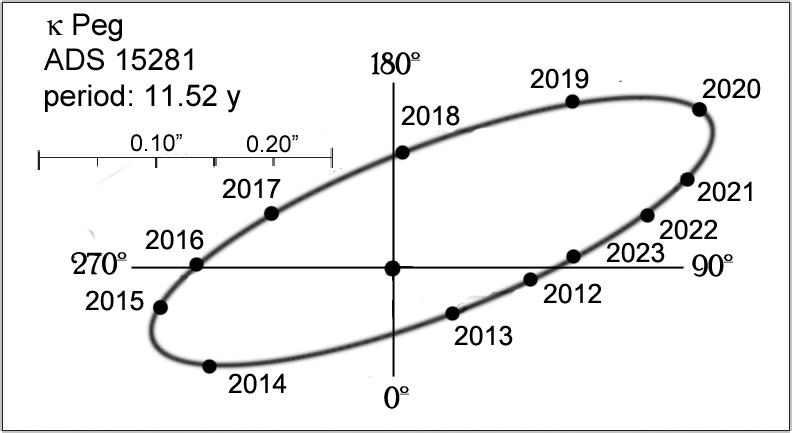
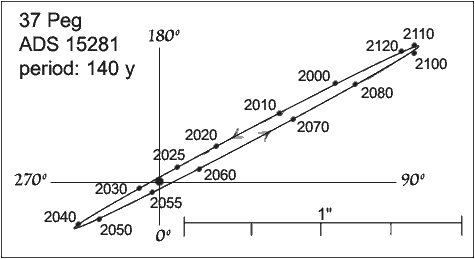
37 Pegasi is another close binary, with an orbit of 140 years: 5.8, 7.1; presently the
companion is found at PA 117º and separation of 1.0".
85 Pegasi is a well-known close binary with orbit of 26.27 years: 5.8, 8.9; currently the
companion is at PA 273º and separation of 0.8".
Epsilon Pegasi is an irregular (Lb type) variable, and a flare star
with a relatively cool shell. This supergiant can get as bright as 0.7
magnitude, and dimmer than 3.5. Generally it stays around 2.4.
Pegasus has many galaxies and an outstanding globular cluster.
NGC 7331 is a spiral galaxy resembling the Milky Way Galaxy; it's
as if we were looking at outselves from fifty million light years away.
NGC 7479 is a barred spiral galaxy about three degrees due south
of alpha Pegasi.
Stephan's Quintet is a noted cluster of galaxies half a degree
SSW of NGC 7331. See how many of the five you can spot (three is
average, four is good).
For a more detailed appreciation of Pegasus, visit the Binocular Section.
Or go to
the Main Menu
|