|
|
|
And yet Hercules boasts one of the finest collection of binary stars,
and two Messier objects as well.
Heracles was named after the greatest of Greek goddesses, Hera. Her name
means "Lady" and she was the daughter of Cronus, and sister of Zeus (they
were twins). Zeus later changed into a cuckoo and seduced his sister (he
had that kind of reputation), and the two were married.
Hera became the Queen of the Heavens: goddess of childbirth, marriage, and
of women, she was the most widely beloved of goddesses in antiquity. It
would only be natural that the greatest of Greek heroes would be named
after her: Heracles means "the glory (or honour) of Hera".
Although named after Hera, Heracles didn't have her immediate respect.
Heracles was the son of Zeus and a mortal woman (Alcmene). Hera resented
Zeus' philandering nature, and tried to have the child killed. She sent
two monstrous snakes to his crib, but the infant strangled them both
with his pudgy little hands.
Heracles became a favourite with the gods. Apollo made his bow and
arrows; Athene gave him a magnificent robe; Hermes provided him with a
sword, and Castor (the greatest warrior) taught him how to use it.
Hephaestus, the smithy of the gods, made a golden breastplate for
Heracles. Thus armed and protected, Heracles paraded through
Greek mythology, performing eight heroic deeds and the Twelve Labours.
In fact, the very word "hero" has links with the names Hera and
Heracles. The Romans would change his name to Hercules (and hers to
Juno, and Zeus to Jupiter).
<
The principal stars are found farther south. Star hop from theta over to
pi Herculis, and then to the southwest (about the same distance from pi
Herculis to Vega) is beta Herculis, which is actually the brightest
star in the constellation.
Now look southeast and you will come across alpha Ophiuchi (Ras
Alhague), at 2.1 magnitude, the brightest star of the region. Alpha
Herculis is northwest of this star.
This is a fine double: a red (or orange) supergiant and a blue-green giant
(see below). The primary is also an irregular variable (see below).
Note: the data on binaries has been updated in the Binocular Section; see the link below.
Hercules has several binaries with contrasting colours, as well as
several close binaries, challenging those with larger telescopes.
Zeta Herculis is a rapid binary with
colour contrast, a yellow primary and red companion with a period of 34.45
years: 2.9, 5.5. The 2000 values: PA 12º degrees, and the separation
0.7".
Kappa Herculis is an easily resolved binary: 5.3, 6.5; PA 12 degrees,
separation 28.4".
Rho Herculis: two white stars which make a lovely double. 4.6,
5.6; PA 326, separation 4.1".
95 Herculis is a very attractive double with contrasting colours,
often described as gold and silver (although you may disagree): 5.0, 5.1;
PA 258 degrees, separation 6.3".
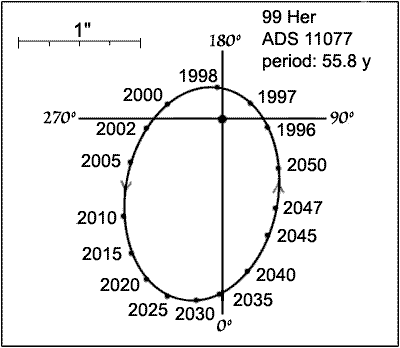
99 Herculis is a very close rapid binary:
5.1, 8.4; currently the PA is 92 degrees and the separation 0.3".
100 Herculis is another gorgeous binary of two equal white stars
easily resolved. 5.9; 5.9; PA 183 degrees, separation 14.2"
Struve 2319. This is a very beautiful binary of two rather faint
stars: 7.2, 7.6; PA 191 degrees, separation 5.4".
Alpha Herculis is an irregular variable with a range from 2.7 to
4.0, with a period of roughly three months.
S Herculis is the brightest long-period variable in Hercules, with
a visual magnitude range of 6.4-13.8 every 318.14 days. The maximum for
the year 2000 should occur in mid July.
There are two Messier objects in Hercules: M13 and M92.
M13 (NGC 6205) is a spectacular globular cluster sometimes known
as "The Hercules Cluster". It is universally acclaimed as the best
globular in the northern hemisphere.
M13 lies on a line between eta Herculis and zeta Herculis, due west of
pi Herculis.
M92 (NGC 6341) is also a globular cluster, located nine degrees
northeast of M13, and six degrees directly north of pi Herculis.
M92 is also very striking and worthy of consideration, even if considerably
overshadowed by M13.
For a more detailed appreciation of Hercules, visit the Binocular Section.
|
Or go to
the Main Menu
All files associated with The Constellations Web Page are
© Richard Dibon-Smith.